Chapter I
The long silence
On deep time, perishable meaning, and the treacherous art of reading minds from stones.
Start with scale, because every other mistake follows from getting it wrong. The genus Homo is roughly two and a half to three million years old; a jawbone from Ledi-Geraru in Ethiopia pushes the lineage back to about 2.8 million years. Anatomically modern Homo sapiens appears, in the fragmentary form of skulls from Jebel Irhoud in Morocco, by around three hundred thousand years ago. Farming begins, in a handful of places, about twelve thousand years ago. Writing appears about five thousand years ago. If the whole history of our species were compressed into a single day, writing would arrive in the last twenty-five minutes. Everything the scriptures say, everything the philosophers argued, everything the historians recorded, happened in the final half hour. The rest of the day is prehistory.
That is the first insight, and it is humbling: the religious, moral, and emotional equipment that human beings brought to the first cities was not invented there. It was inherited from a vast, pre-literate past in which people lived in small mobile bands, knew every member of their world by name, depended on animals they also revered, and faced death without hospitals, histories, or any written promise of what came after. Whatever the primordial psyche was, it is not a curiosity. It is the ground floor of the building we still live in.
What survives, and what does not
The archaeologist's first discipline is taphonomy, the study of what happens to things after they are dropped, buried, or abandoned. Bone survives in the right soils and dissolves in acidic ones. Stone survives almost everywhere. Charcoal survives, which is why fire can sometimes be dated. Pigment survives on protected rock surfaces and inside caves. Wood, fibre, hide, feathers, and flesh almost always vanish. So do sound and movement.
This produces a distortion so deep that it can shape a whole theory of human nature. When we say that people of a given period "made stone tools," we mean that stone tools are what we found. When studies of hunter-gatherers still living in the nineteenth and twentieth centuries catalogue their material culture, the majority of it, by count, is perishable: digging sticks, nets, baskets, carrying bags, spears, shields, body paint, feather headdresses, carved wooden figures, bark paintings, string. Archaeologists working in Australia have long made the point with a thought experiment: if Aboriginal Australia were known only from its stone tools, one might conclude its people had no religion at all. In fact they possessed one of the most intricate cosmologies ever recorded, almost none of it written in stone.
If the deep past were judged only by its stone tools, one would conclude its people had no religion at all.
The same logic applies to the Palaeolithic. The painted caves of Europe are spectacular because paint on limestone, sealed from wind and rain, can last tens of thousands of years. But for every cave there must have been thousands of painted bodies, painted hides, painted trees, and painted bark sheets that simply ceased to exist. For every carved ivory figurine there were, surely, many more carved in wood. For every bone flute recovered from a German cave there were reed pipes, drums of skin, clapping sticks, and, above all, voices. The silence of prehistory is an artefact of preservation. It is not evidence that the past was quiet.
The ladder of inference
The British archaeologist Christopher Hawkes, in 1954, proposed what came to be called Hawkes's ladder of inference. At the bottom rung, he argued, it is relatively easy to infer technology from archaeological remains: how a tool was made. One rung up, subsistence economy: what people ate. Higher still, and harder, social and political organization. At the very top, hardest of all, religious institutions and spiritual life. The higher you climb, the more your conclusions rest on analogy, assumption, and imagination.
Hawkes was right about the difficulty, but later generations of archaeologists pushed back on his pessimism. The cognitive archaeologist Colin Renfrew argued that belief, precisely because it motivates behaviour, leaves behaviour's traces: repeated, formalized actions in special places, investment of labour far beyond practical need, deliberate destruction or deposition of valuable objects, attention-focusing devices such as enclosures and imagery, and the association of objects with the dead. Religion, on this view, is not invisible. It is expensive, and expense leaves marks.
That idea, that the sacred can be recognized by its cost, will run through this whole essay. A burial is a costly act in an economy where time spent digging is time not spent foraging. A cave painting done a kilometre underground by the light of a fat lamp is costly. So is carrying a heavy stone to a hilltop, or spending hundreds of hours drilling beads to adorn a corpse. When human beings behave in ways that are wildly uneconomical, they are usually telling us that something matters more to them than economy.
The problem of the living mirror
The second great tool of inference is ethnographic analogy: the use of recently documented hunter-gatherer societies, such as the San of the Kalahari, the Hadza of Tanzania, the Mbuti of the Congo Basin, the Inuit, the Andaman Islanders, the Chewong of Malaysia, and Aboriginal Australians, as windows onto the lifeways of the Palaeolithic. It is indispensable and it is dangerous.
It is indispensable because it is the only way to populate our imagination with anything more than guesswork. Studies of foragers show recurrent patterns: small bands of perhaps twenty-five to fifty people who periodically aggregate into larger gatherings of several hundred; fierce egalitarianism, enforced by mockery and sharing norms against anyone who tries to dominate; kinship systems that extend "family" far beyond biological relatives; widespread beliefs in spirits of animals and places; religious specialists, often called shamans, who enter altered states on behalf of the group; and deep, often ambivalent relationships with the dead. These recurring features are at least suggestive that some such pattern characterized the long human past.
It is dangerous because recent foragers are not fossils. The San have a history as long as anyone's. They have been in contact with herders and farmers for centuries, and pushed into marginal lands. Their religion has changed, borrowed, reinvented. To treat them as a preserved specimen of "early man" is both bad science and a form of disrespect that colonial scholarship too often indulged. The better use of ethnography is not as a photograph of the past but as a catalogue of possibilities: it tells us the range of ways in which human beings without states, scripts, or agriculture have actually organized their minds and societies. The past was almost certainly within that range, and possibly outside it.
The first hints of a mind beyond need
With those cautions in hand, we can look at the earliest evidence that hominins were doing something more than surviving.
The Acheulean hand axe, which appears in Africa about 1.76 million years ago and persists for well over a million years, is the longest-lived designed object in the human record. Many are more symmetrical than function would require. Some are made from unusually colourful stone. A few are enormous, too large to use comfortably. A handful, including a famous hand axe from West Tofts in England, were knapped around a fossil shell embedded in the flint, leaving it at the centre of the finished piece. It is impossible to prove what this meant. But it is hard to look at such objects without feeling that someone was paying attention to form for its own sake, that an aesthetic sense, or at least a sense of the "rightness" of a shape, had begun to separate itself from pure utility.
In 2014, researchers re-examining a freshwater mussel shell collected in the 1890s at Trinil, on Java, noticed a zigzag line engraved on its surface. The shell had been collected in the same deposits as the first Homo erectus fossils and has been dated to roughly half a million years ago. The engraving seems to have been made deliberately with a sharp point. No one knows what it meant; possibly nothing more than the pleasure of a line. But if the attribution holds, it suggests that the impulse to make a mark, to put pattern onto the world, is older than our species.
Then there is fire. The evidence for hominin fire use at sites such as Wonderwerk Cave in South Africa may reach back a million years, while habitual, controlled use becomes clearer by around four hundred thousand years ago. Fire's practical importance is obvious: cooking, warmth, protection from predators. Its psychological importance is less obvious but may be just as profound. The anthropologist Polly Wiessner, recording conversations among the Ju/'hoan San, found that daytime talk was dominated by economic matters, complaints, and gossip about rule-breakers, whereas talk around the fire at night turned overwhelmingly to stories, often about people who were absent, dead, or imaginary. Firelight, she argued, extended the day into a new kind of time: a time for narrative, for the social imagination, for the dead and the unseen. It is not unreasonable to suggest that the first cosmologies were fireside cosmologies.
Firelight extended the day into a new kind of time: a time for narrative, for the dead, and for the unseen.
Red earth
If there is a single substance that stands at the threshold of human symbolic life, it is red ochre, an iron-oxide-rich earth that can be ground into a pigment ranging from dull brown to vivid blood-red. Ochre has practical uses: it can serve as a sunscreen, an insect repellent, a hide preservative, and an ingredient in hafting adhesives. But its archaeological record is so persistent, and so often associated with bodies, graves, and images, that almost no one now believes its use was purely practical.
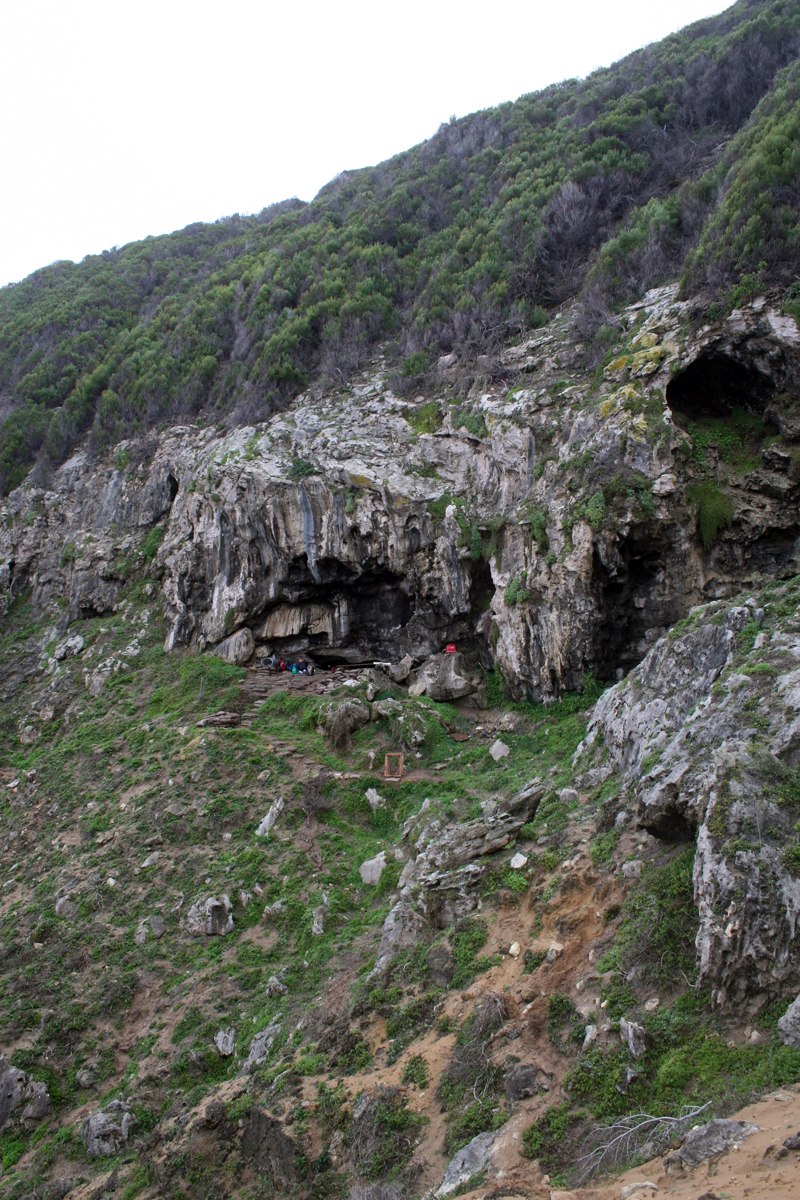
At Pinnacle Point on the southern coast of South Africa, ochre appears in deposits dated to about 164,000 years ago. At Blombos Cave, on the same coast, archaeologists led by Christopher Henshilwood found an ochre-processing workshop dated to around 100,000 years ago, complete with abalone shells used as mixing containers, grinding stones, and bone residues that suggest the pigment was being prepared as a paint. Blombos also yielded pieces of ochre deliberately engraved with crosshatched patterns, dated to around 75,000 years ago, and a flake of silcrete bearing a drawn crosshatch in red ochre, dated to about 73,000 years ago, the oldest known drawing in the world.
Why red? Across a remarkable range of cultures, red is the first colour term after black and white, a pattern documented by the anthropologists Brent Berlin and Paul Kay in the 1960s. It is the colour of blood, and therefore of life, injury, menstruation, birth, and death. The anthropologist Chris Knight and his collaborators have gone further, proposing that ochre was central to a "female cosmetic coalition" in which women used red pigment to signal and manage fertility, a theory that is provocative, contested, and ingenious in equal measure. One need not accept it to see the point: a substance that looks like blood but does not decay could hardly have been neutral to a mind that was beginning to think about the boundaries of life.
Beads, and the invention of the social self
The second great sign is the bead. Perforated shells of the small marine snail Nassarius have been found, some coloured with ochre and worn from stringing, at Blombos Cave, at around 75,000 years ago; at Grotte des Pigeons at Taforalt in Morocco, at around 82,000 years ago; and at Skhul in Israel, possibly older still. Some of these shells were carried dozens of kilometres inland from the sea.
A bead is a small object with a large implication. Worn on the body, it communicates something to other people: membership, status, age, marital condition, allegiance, perhaps protection. It works only if others share the code. In that sense, a bead is a sentence in a public language, and its presence tells us that people were living in a world where the self was not just a body but a displayed identity, readable at a distance by people one might not know well. This matters enormously for the history of religion, because religion, in almost every known form, is a technology for extending trust and belonging beyond the circle of immediate kin.
Revolution or slow dawn?
For much of the twentieth century, the standard story held that the modern human mind "switched on" suddenly around 40,000 to 50,000 years ago, in what was called the Upper Palaeolithic Revolution, visible in Europe as a sudden flowering of cave art, figurines, musical instruments, elaborate burials, and new tool types. Some researchers, notably the archaeologist Richard Klein, argued that this reflected a genetic change in the brain, perhaps affecting language.
In 2000, the archaeologists Sally McBrearty and Alison Brooks published a paper with the pointed title "The Revolution That Wasn't." Reviewing the African evidence, they showed that the elements of the supposed revolution, including blades, pigment use, shell beads, long-distance exchange, bone tools, and engraving, appeared piecemeal across Africa over a period of more than two hundred thousand years. Europe looked revolutionary, they argued, only because modern humans arrived there with an already-assembled package. The dominant view today is closer to theirs: symbolic behaviour emerged gradually, flickered on and off in different regions, and depended as much on population density and social networks as on any change in the brain. When groups were large and connected, cultural knowledge accumulated; when they were small and isolated, it could be lost.
That is a crucial insight for understanding the primordial psyche. It suggests that the capacity for symbolic, religious thought was probably present in our species from early on, perhaps from its beginning, but that its visible expression depended on social conditions. A mind capable of imagining spirits is not the same as a society that builds shrines to them. Between capacity and culture lies the whole history that follows.
We now know enough to ask the question that anchors the rest of this inquiry. When a creature capable of symbols, social identity, and firelit storytelling looks at a dead companion, what does it see? The answer, as far as the record allows us to hear it, begins in the grave.